
What Designed Ambition means
Or: Why I renamed this thing

A few months ago I started writing about building in public. The messy journey. The real stuff.
But somewhere along the way, the writing became about something else entirely.
It became about ambition itself.
Not the hustle-culture, grind-until-you-break kind. Something different. Something I didn’t have language for until recently.
So I renamed the publication.
Designed Ambition.
Here’s what that means to me.
The Rand Problem
I’ve read everything Ayn Rand ever wrote.
Not just the novels—though The Fountainhead hit me like a truck at twenty-two. I mean the philosophy. Introduction to Objectivist Epistemology. The Virtue of Selfishness. The Peikoff lectures on consciousness and concept-formation.
Most people treat Rand as a political writer. A capitalist cheerleader. A relic of Cold War ideology.
That’s not what I found.
What I found was a philosopher asking a simple question: What does it mean to live as a rational, self-valuing being?
Her answer was uncomfortable. You don’t borrow your values from the crowd. You don’t sacrifice your highest capacity to avoid standing out. You don’t apologise for wanting greatness.
But here’s where most readers stop.
They take the intensity and run with it. They build identities around maximising difficulty. They treat struggle as proof of worthiness. They become the guy who chooses the hardest possible road because anything easier feels like settling.
I was that guy.
And she would have called me out on it.
Ambition From Fullness
Here’s the thing most people miss about Rand’s ethics.
Self-interest isn’t about chasing. It’s about having.
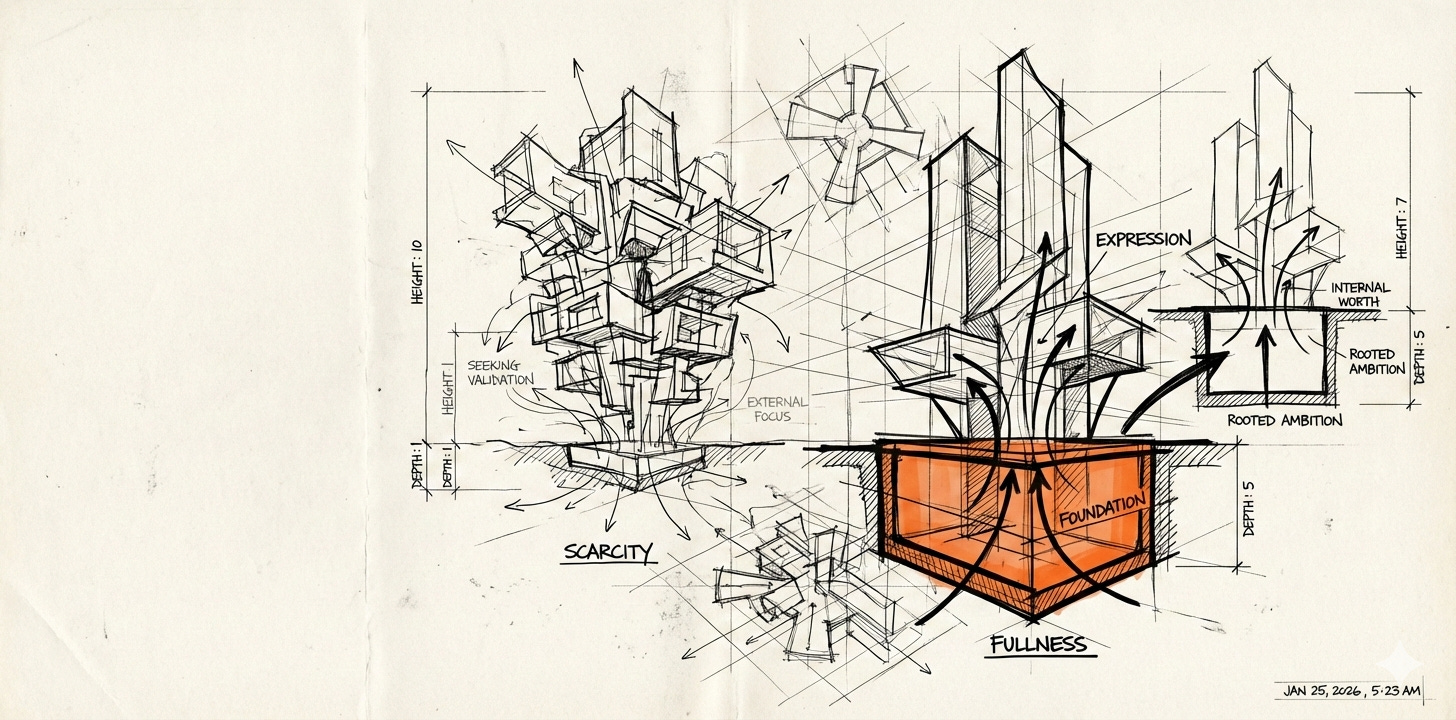
The selfish person, in her framework, doesn’t act from scarcity. They act from abundance. They don’t need external validation because their self-worth is the foundation, not the goal.
That distinction changes everything.
Ambition rooted in scarcity looks like this: I need to prove myself. I need to do the hardest thing. I need the world to confirm that I matter.
Ambition rooted in fullness looks different: I already have what I need. Now what do I want to build with it?
One is compensation. The other is expression.
I spent years confusing them.
Becoming a parent clarified it.
I live in my favourite place in the world. I have a great house, the best wife I can imagine, a close community. I have hobbies I care deeply about. A career that makes an impact. A love of learning that means I never tire of working.
I already have the life. Now I get to build from it.
That’s fullness. And it changes what ambition feels like.
The Design Part
I’m an architect by training. And although I’ve never been a practicing one, the thinking sticks.
Architects don’t worship constraint. They use it.
A building without a site, a brief, or a budget isn’t a vision. It’s a fantasy object. Add constraints and the design sharpens. Add more and it sharpens again.
Responsibility works the same way.
When I became a father, my constraints multiplied. Partner needs stability. Kids need attention. Time becomes finite in a way that used to feel abstract.
Old me would have seen that as limitation.
New me sees it as design input.
The right constraints don’t shrink ambition. They reveal which ambition actually belongs to you.
What This Publication Is About
Designed Ambition is for people who refuse the false choice.
The choice between greatness and everything else that matters.
The choice between career and family.
The choice between ambition and responsibility.
Those aren’t trade-offs. They’re failures of design.
If your ambition requires sacrificing every other part of your life, the problem isn’t your life. The problem is your ambition wasn’t designed for the person you actually are.
This publication is about building ambition intentionally.
Ambition that comes from self-worth, not compensation.
Ambition that treats constraints as design rules, not cages.
Ambition that integrates every facet of who you are—builder, parent, thinker, strategist—instead of pitting them against each other.
What I’m Not Doing
I’m not prescribing a path.
I’ve written before about killing GearShare, about the ego death that came with it, about rebuilding an identity that outlasts any single project. That wasn’t advice. That was documentation.
This is still documentation.
I’m figuring this out as I go. Some of it will be wrong. Some of it will change. The point isn’t to have answers. The point is to think clearly about questions most people avoid.
What does ambition look like when you already have what you need?
How do you build something great without losing everything else?
What’s the relationship between self-worth and the drive to create?
These aren’t productivity questions. They’re philosophical ones.
And I think they deserve more rigour than “follow your passion” or “hustle harder.”
The Long Game
My kids won’t remember my launches.
They’ll remember who I was while building.
That’s the real work. Not the products. Not the projects. The person underneath.
Designed Ambition is about building that person intentionally.
A durable identity that outlasts any shiny new thing.
Ambition as architecture, not impulse.
If any of that resonates, stick around.
I love the concept of designed ambition, it certainly mirrors my own personal journey and relationship to work and how it’s evolved over time. And your comment about constraints, using it as a design input rather than seeing it as a limitation, such a helpful reframing!
Looking forward to reading more of your work, this one resonated with me a lot.